Wisdom For Your Dome
Alcohol and Sleep: Why the Nightcap Is a Scam
Reviewed by Dr. Pegah Panahi, MD — 25+ years in holistic and cannabinoid medicine.
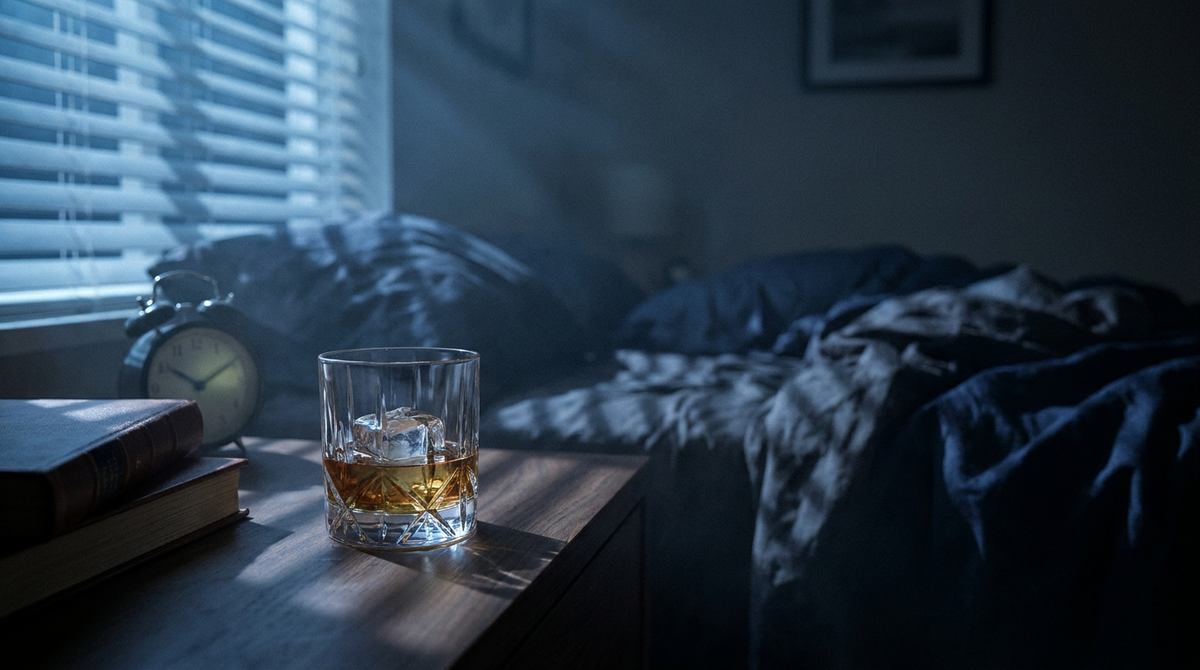
Two glasses of wine. Asleep in eleven minutes. Awake at 3AM, heart pounding, staring at the ceiling like it owes you money. Congratulations — you've just experienced the oldest scam in sleep: the nightcap. Humans have been prescribing themselves booze for bedtime since someone first fermented a grape, and the science on alcohol and sleep says we've been wrong the entire time.
Quick answer: Alcohol makes you fall asleep faster but makes your sleep worse. It suppresses REM sleep, fragments the second half of the night, and often triggers early-morning wakeups as your body finishes metabolizing it. Even moderate drinking close to bedtime reduces overall sleep quality, which is why a nightcap leaves many people tired after a full night in bed.
TL;DR — the short version
- Alcohol is great at knocking you out and terrible at keeping you asleep.
- It suppresses REM sleep — the mentally restorative stage — especially in the first half of the night.
- Your body clears roughly one standard drink per hour; when it finishes, your nervous system rebounds and can jolt you awake around 3AM.
- Alcohol also relaxes throat muscles and increases snoring, plus it's a diuretic — hello, 2AM bathroom trip.
- A better wind-down: cut off drinks 3–4 hours before bed and build a routine your brain actually associates with sleep.
How does alcohol affect sleep?
Alcohol affects sleep by speeding up sleep onset while disrupting sleep architecture later in the night — it suppresses REM sleep, increases the number of brief awakenings, and shifts the second half of the night toward lighter, more fragmented sleep. That's the whole con in one sentence: you trade eleven minutes of faster unconsciousness for hours of garbage-tier sleep.
Here's the mechanism. Alcohol is a depressant, so it quiets brain activity on the way down — that's the part that feels like it "works." But sleep isn't one thing. It's a structured cycle of light sleep, deep sleep, and REM, repeating four to six times a night. Alcohol bulldozes that structure. Early in the night you get a heavier-than-normal dose of deep sleep, which sounds nice until the bill arrives: REM gets squeezed out, and REM is where your brain files memories and processes the emotional junk drawer of your day.
Skimp on REM and you wake up technically rested and mentally fried — foggy, irritable, weirdly emotional about a commercial. Sleep like the dead, wake up like the undead.
Why does alcohol wake you up at 3AM?
Alcohol causes middle-of-the-night wakeups because your body metabolizes roughly one standard drink per hour, and once the alcohol is gone, your nervous system rebounds in the opposite direction — more arousal, lighter sleep, and a spike in wakefulness that often lands somewhere around 3AM. Researchers call it the rebound effect. You'll call it lying in the dark doing your taxes from memory.
If that hour sounds familiar, it's the same window we covered in why you wake up at 3AM every night — and alcohol is one of the most reliable ways to guarantee a front-row seat. Stack a nightcap on top of stress hormones and a warm bedroom, and your odds of sleeping through the night approach lottery-ticket territory.
Booze also piles on side quests:
- Snoring and breathing disruption. Alcohol relaxes the muscles in your throat, which narrows your airway. Louder snoring, more micro-arousals, angrier partner.
- Bathroom runs. It's a diuretic. Your bladder does not care that you were finally in deep sleep.
- Dehydration. Mild dehydration plus fragmented sleep is the recipe for that dusty, cotton-mouthed 6AM feeling.
Does a nightcap help you sleep at all?
No — a nightcap helps you fall asleep, which is not the same thing as helping you sleep. The distinction matters. Total sleep is only useful if it's structured sleep, and alcohol delivers unstructured sleep: front-loaded, fragmented, REM-starved. Studies of evening drinking consistently find reduced sleep quality even at moderate doses, and the more you drink, the worse the back half of your night gets.
There's also a tolerance trap. Use alcohol as a sleep tool regularly and its knockout effect fades within days, so people pour more to get the same effect — worse sleep, bigger dose, repeat. It's the same escalation problem we've written about with melatonin side effects: the "easy button" for sleep usually has a hidden invoice.
How long before bed should you stop drinking?
A good rule of thumb is to stop drinking at least 3–4 hours before bed, longer if you've had more than one or two drinks. Since your body clears roughly one standard drink per hour, that buffer gives your system time to finish the metabolic cleanup before you're trying to cycle through deep sleep and REM.
If you're going to drink anyway
- Front-load it. Drinks at happy hour beat drinks on the couch at 10PM.
- Alternate with water. Less dehydration, fewer 2AM bathroom missions.
- Skip the sugary cocktails — sugar before bed is its own sleep wrecker, and a margarita is basically a candy bar with a permit.
- Don't stack alcohol with a heavy late meal. Your body can run digestion or sleep architecture well — not both.
What to do instead of a nightcap
The nightcap survives because it's a ritual — the glass, the couch, the exhale. You don't need the ethanol; you need the off-ramp. Build a consistent nighttime routine — dim lights, screens down, same sequence every night — and your brain learns the cue just as well, minus the 3AM rebound.
And if you want something in the glass-and-ritual category that isn't working against you, this is exactly the lane cannabinoids live in. Many people find a full-spectrum CBD gummy about an hour before bed helps them wind down and shut their brain up without the REM tax or the morning fog. It's not a knockout drug — it's a wind-down tool, which is the point. Here's how to actually use CBD for deep sleep if you want the full playbook.
Retire the nightcap. Keep the ritual.
Doze Drops — 50mg full-spectrum CBD + 20mg CBN + 20mg CBG per gummy. Zero sugar. Doctor formulated. Non-habit-forming. Designed to help you wind down and stay down — no rebound, no hangover.
$29.99 · 30-day money-back guarantee.
Frequently asked questions
Does alcohol help you sleep?
Alcohol helps you fall asleep faster, but it reduces overall sleep quality. It suppresses REM sleep, fragments the second half of the night, and often causes early-morning wakeups as it wears off, so most people wake up less rested after drinking.
Why do I wake up at 3AM after drinking?
Your body metabolizes roughly one standard drink per hour. Once the alcohol is cleared, your nervous system rebounds toward arousal, producing lighter sleep and a spike in wakefulness that commonly lands in the middle of the night, often around 3AM.
How long before bed should I stop drinking alcohol?
Stop drinking at least 3–4 hours before bedtime, and extend that buffer if you have more than one or two drinks. This gives your body time to metabolize the alcohol before your key sleep stages, reducing rebound wakeups and REM disruption.
Is CBD a good alternative to a nightcap?
Many people use a CBD gummy as a nightly wind-down ritual in place of an evening drink. Full-spectrum CBD products like Doze Drops are designed to support relaxation and a calmer transition into sleep, are non-habit-forming, and don't carry alcohol's REM suppression or rebound wakeups. CBD is not a treatment for any sleep condition.
These statements have not been evaluated by the Food and Drug Administration (FDA). This product is not intended to diagnose, treat, cure, or prevent any disease. The information provided is for educational purposes only and is not medical advice. Always consult a healthcare professional before starting any new supplement, especially if you are pregnant, nursing, have a medical condition, or take medications. Results may vary. Everwell does not make any health claims regarding its CBD products.