Wisdom For Your Dome
Blue Light and Sleep: How Screens Keep You Wired
Reviewed by Dr. Pegah Panahi, MD — 25+ years in holistic and cannabinoid medicine.
Quick answer: Blue light delays sleep because your eyes read short-wavelength screen light as daytime, suppressing and delaying melatonin — the hormone that signals your body to power down. Night mode helps only modestly; brightness, distance, duration, and stimulating content all still matter. The real fix: dim the house after sunset, set a 30–60 minute screen curfew, and charge the phone outside the bedroom.
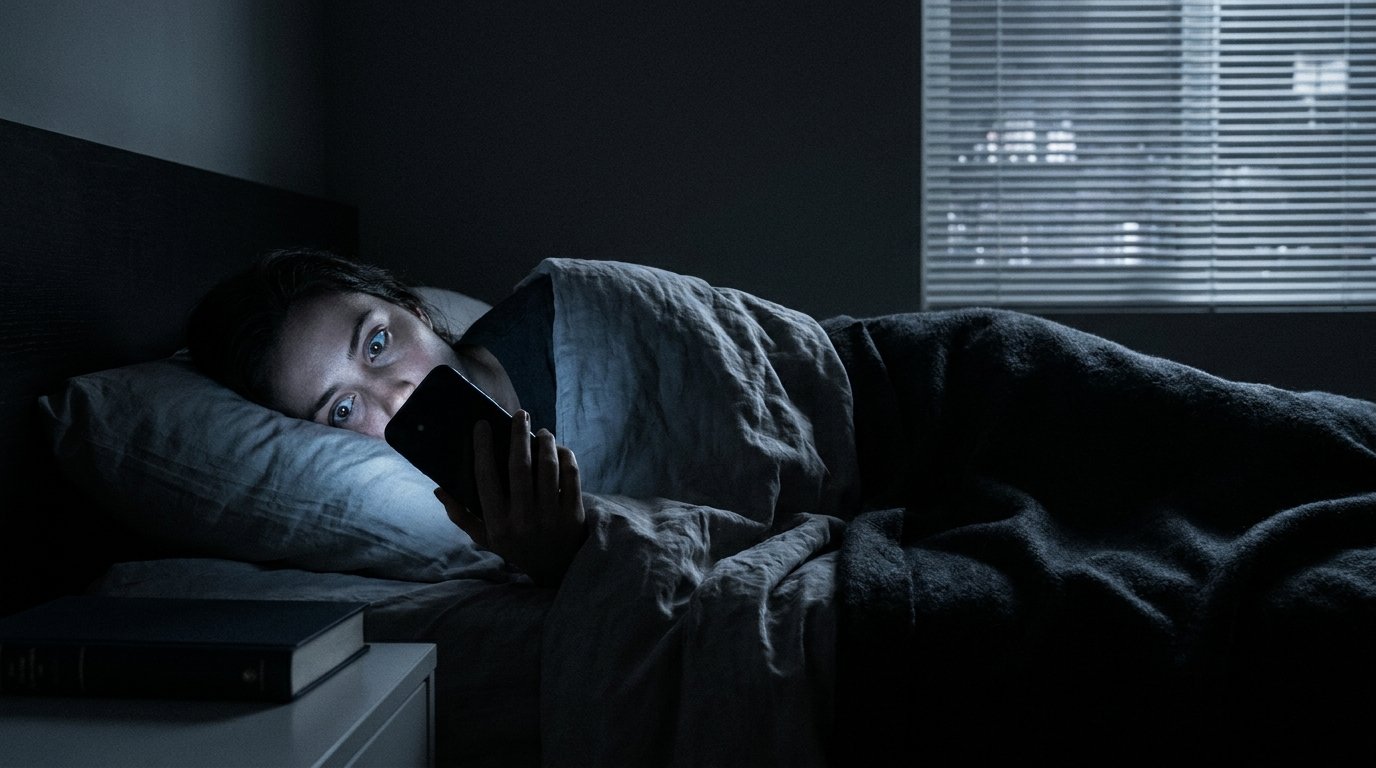
It's 11:47 PM. You're exhausted. You've been exhausted since 3 PM. And yet here you are, face lit up like a gas station sign, telling yourself one more scroll. Here's the ugly relationship between blue light and sleep: that screen is quietly telling your brain it's noon, and your brain — bless it — believes the screen over the actual clock. So you lie there, tired and wired, wondering why you can't shut your brain up. It's not a character flaw. It's biology, and your phone is exploiting it.
The Short Version (TL;DR)
- Blue light is the wavelength your brain reads as "daytime." Screens pump it straight into your eyeballs at midnight.
- It suppresses and delays melatonin — the hormone that tells your body it's time to power down.
- Night mode helps a little. It does not make midnight scrolling harmless.
- The content on the screen wires you up just as much as the light does.
- The fix: dim everything after sunset, get screens out of bed, and build a wind-down that doesn't involve a feed.
Your Phone Is Gaslighting Your Brain
Your eyes contain specialized cells (intrinsically photosensitive retinal ganglion cells, if you want to win a bar bet) that don't help you see at all. Their whole job is detecting light — especially short-wavelength blue light, around 480 nanometers — and reporting it to your brain's master clock.
For most of human history, that system worked great. Blue-rich light meant the sun was up. Warm, dim light meant fire, evening, bedtime. Then we invented a glowing rectangle that emits daytime-spectrum light, and we started staring at it from eight inches away while horizontal in bed.
Your circadian system has no idea it's being played. It just reports what it sees: bright, blue-ish light. Conclusion: daytime. Melatonin: cancelled.
What Blue Light Actually Does to Your Melatonin
Melatonin isn't a sedative — it's a signal. Your pineal gland releases it in the evening as a memo to the rest of your body: dim the lights, we're closing up. Research has found that evening light exposure, particularly blue-wavelength light, can suppress melatonin release and push its onset later. Bright screen use in the evening has been linked to delayed melatonin timing, longer time to fall asleep, and less morning alertness.
That's the blue light and sleep problem in one sentence: the memo goes out late, so everything downstream runs late. You feel sleepy later, you fall asleep later, and your alarm doesn't care about any of it. Do this nightly and you're essentially giving yourself a mild case of permanent jet lag — without the vacation.
If you're also waking up anxious at weird hours, that's a related mess — we broke down the stress side of the equation in our guide to quieting racing thoughts at night.
"But I Use Night Mode"
Sure you do. Night Shift, dark mode, blue light glasses — the wellness industry loves selling you a hall pass for a bad habit.
Here's the honest read: shifting your screen warmer and dimmer is genuinely better than full-brightness blue-white light. Do it. But studies on night-mode settings have found the melatonin benefit is modest at best — because brightness, screen distance, and duration all still matter, and because a warm-tinted screen at 100% brightness held six inches from your face is still a flashlight pointed at your circadian clock.
Night mode is a seatbelt. It is not an excuse to drive into the wall.
It's Not Just the Light — It's the Feed
Blaming wavelengths alone lets your phone off easy. The other half of the problem is what's on the screen: outrage, notifications, one more episode, someone being wrong on the internet. That stuff spikes alertness and stress arousal at the exact moment your nervous system should be downshifting.
Light delays the sleepy signal; content stomps on the brakes. Together they're why you can be bone-tired and wide awake at 1 AM. We wrote a whole post on that particular doom spiral: how doom-scrolling destroys your sleep.
How to Actually Fix It (Without Moving to a Cabin)
You don't need to throw your phone in a lake. You need friction and better light hygiene:
- Dim the house after sunset. Lamps, not overheads. Warm bulbs. Your ancestors had firelight; you can have a $12 warm LED.
- Set a screen curfew — 60 minutes before bed. Can't do 60? Do 30. Something beats nothing.
- Get the phone out of the bedroom. Charge it in the kitchen. Buy an actual alarm clock like it's 1997. The bed is for sleep, not for a glowing anxiety machine.
- If you must use a screen, handicap it. Night mode on, brightness at minimum, held farther from your face, and boring content only.
- Get bright light in the morning. Ten minutes of real daylight anchors your clock and makes evening melatonin show up on time. Blue light isn't the villain — blue light at midnight is.
- Replace the scroll with an actual wind-down. Here's how to build a nighttime routine that doesn't require a feed.
Your Wind-Down, Upgraded
You've dimmed the lights and banished the phone. Now give your brain something to do besides replaying that thing you said in 2019. Doze Drops are doctor-formulated sleep gummies designed to help you wind down: 50mg full-spectrum CBD + 20mg CBN + 20mg CBG per serving, zero sugar, non-habit-forming. No melatonin hangover, no gas station mystery gummies. $29.99, backed by a 30-day guarantee — because many people find their wind-down works better when their nervous system gets the memo too.
Frequently Asked Questions
Does blue light really affect sleep?
Yes. Evening exposure to blue-wavelength light can suppress and delay melatonin release, which pushes back your body's internal bedtime and can make it take longer to fall asleep. Brightness, duration, and how close the screen is to your eyes all matter.
How long before bed should I stop looking at screens?
A common recommendation is 30–60 minutes before bed. The bigger wins are dimming your overall home lighting in the evening and keeping the phone out of the bedroom entirely.
Do blue light glasses or night mode actually work?
They help somewhat — warmer, dimmer light in the evening is better than bright blue-white light. But research suggests the effect is modest, and neither fixes the alertness spike from stimulating content. Treat them as harm reduction, not a cure-all.
Is blue light bad during the day?
No — it's the opposite. Bright, blue-rich light in the morning helps anchor your circadian rhythm so melatonin shows up on time at night. The problem is timing, not the light itself.
These statements have not been evaluated by the Food and Drug Administration (FDA). This product is not intended to diagnose, treat, cure, or prevent any disease. The information provided is for educational purposes only and is not medical advice. Always consult a healthcare professional before starting any new supplement, especially if you are pregnant, nursing, have a medical condition, or take medications. Results may vary. Everwell does not make any health claims regarding its CBD products.