
Wisdom For Your Dome
CBD Isolate vs. Full Spectrum: Why Cheap CBD Fails You
Reviewed by Dr. Pegah Panahi, MD — 25+ years in holistic and cannabinoid medicine.
Let's settle the CBD isolate vs full spectrum debate before you waste another $19.99 on gummies that do approximately nothing. That bag at the gas station checkout? Almost certainly isolate — a stripped-down, lab-purified powder wearing the CBD name tag while missing everything that makes hemp extract interesting. If you've tried CBD, felt nothing, and concluded the whole category is snake oil, there's a decent chance you didn't try CBD so much as you tried the cheapest possible impression of it.
The short version (TL;DR)
- CBD isolate is 99% pure CBD powder. One molecule, flying solo, everything else stripped out.
- Full-spectrum CBD is the whole plant extract: CBD plus minor cannabinoids (CBN, CBG), terpenes, and trace THC (under 0.3% — not enough to feel).
- Those extra compounds appear to work together — the entourage effect — which is why many people find full-spectrum products noticeably more useful for winding down.
- Isolate is dramatically cheaper to produce, which is why cheap brands love it and rarely mention it on the front of the bag.
- Check the certificate of analysis (COA). No COA, no purchase. That's the whole rule.
What is CBD isolate, actually?
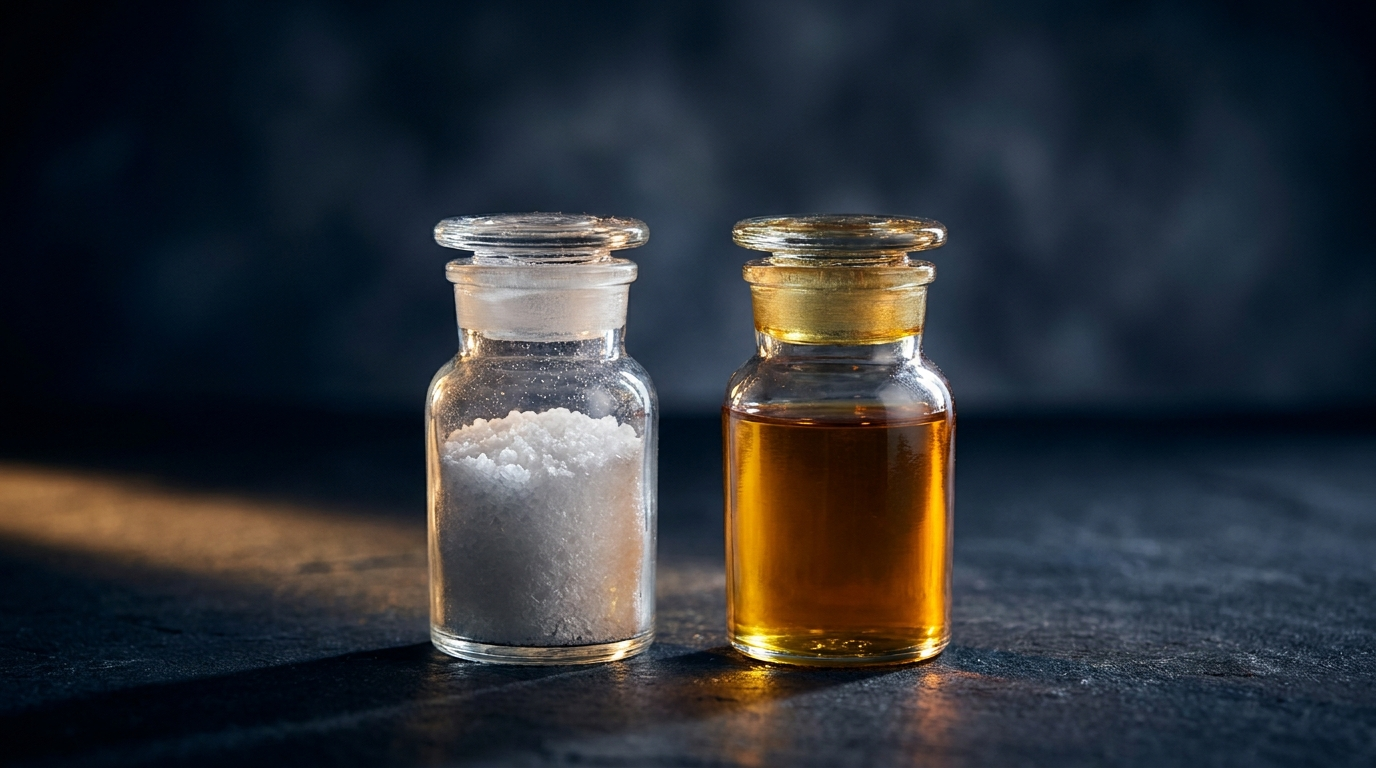
CBD isolate is exactly what it sounds like: cannabidiol, isolated. Manufacturers take hemp extract and refine it until nothing remains but a white crystalline powder that's 99%+ pure CBD. No terpenes, no minor cannabinoids, no plant compounds. Sterile, flavorless, and cheap to churn out at industrial scale.
Purity sounds premium. In supplements, it usually is. But hemp is a strange plant, and CBD appears to behave differently when you strip away its supporting cast — which brings us to the bell curve problem below.
What is full-spectrum CBD?
Full-spectrum extract keeps the plant's full chemical profile intact: CBD as the headliner, plus minor cannabinoids like CBN (the so-called "sleep cannabinoid") and CBG, aromatic terpenes, and a legally-required-to-be-tiny amount of THC (under 0.3% by dry weight — you will not feel it, and it's the same threshold that makes hemp federally legal).
If you want the deeper taxonomy — including where broad-spectrum fits — we've broken it down in full spectrum vs. broad spectrum CBD. The short answer: full-spectrum keeps everything, broad-spectrum removes the THC, isolate removes everything but the CBD.
CBD isolate vs full spectrum: the differences that matter
- Composition: Isolate is one compound. Full-spectrum is dozens working in concert.
- The entourage effect: Research suggests cannabinoids and terpenes may interact synergistically — the whole appearing greater than the sum of its parts. Isolate, by definition, has no entourage. It's one guy at the party.
- Dose response: In preclinical research, isolate showed a bell-shaped dose curve — effects appeared in a narrow dosing window and faded above or below it. Full-spectrum extract showed a more forgiving, dose-dependent response. Translation: with isolate, you have to guess the magic number. With full-spectrum, you mostly don't.
- Cost: Isolate is far cheaper per milligram to produce. That's not automatically evil — it's just why the bargain bin is full of it.
- Taste and character: Isolate is neutral. Full-spectrum has an earthy, botanical edge, because it's actually made of plant.
Why cheap CBD is almost always isolate
Follow the money. Isolate can be bought in bulk for a fraction of the cost of a well-made full-spectrum extract, dumped into gummy bases at whatever milligram count marketing wants, and sold with a leaf on the label. The brand pockets the difference; you pocket a bag of expensive candy.
Worse, the corner-cutting rarely stops at the extract. Independent testing of cheap CBD products has repeatedly found actual CBD content wildly different from the label — sometimes a fraction of the advertised dose, sometimes essentially none. The gas station isn't running quality control on this. Nobody is, unless the brand publishes third-party lab results.
How to spot isolate wearing a full-spectrum costume
- Demand the COA. A certificate of analysis from an independent lab should show the full cannabinoid panel. Full-spectrum products list measurable CBN, CBG, and trace THC. If the panel shows CBD and a row of zeros, that's isolate — whatever the front of the bag claims.
- Check the price per milligram. Genuine full-spectrum extract at a suspiciously low price is a red flag, not a deal.
- Look for named minor cannabinoids with actual doses. "Hemp extract blend" is a shrug. "50mg CBD + 20mg CBN + 20mg CBG" is a formulation.
- "THC-free" plus "full-spectrum" on the same label is a contradiction. That's broad-spectrum at best, isolate at worst.
Doze Drops: full-spectrum, zero costume
We formulated Doze Drops the expensive way on purpose: 50mg full-spectrum CBD + 20mg CBN + 20mg CBG per serving, doctor formulated, zero sugar, non-habit-forming. Designed to help you wind down and shut your brain up — without the isolate shortcut. $29.99, with a 30-day money-back guarantee if your sleep disagrees.
So is isolate ever the right call?
Occasionally, sure. If you're subject to zero-tolerance drug testing, isolate or broad-spectrum removes even trace THC from the equation. If you want flavorless CBD to add to something, isolate dissolves quietly. Those are real use cases. "It was $12 cheaper" is not — because the cheapest option that doesn't do anything is still overpriced.
For most people whose goal is winding down at night, the full plant is the point. Many people find full-spectrum products meaningfully more effective for relaxation than isolate at the same milligram count — which matches what the dose-response research would predict.
Frequently asked questions
What's the main difference between CBD isolate and full-spectrum CBD?
Isolate is 99%+ pure CBD with everything else removed. Full-spectrum keeps the plant's other cannabinoids (like CBN and CBG), terpenes, and trace THC under 0.3%, which may work together via the entourage effect.
Will full-spectrum CBD get me high?
No. Legal full-spectrum products contain under 0.3% THC by dry weight — a trace amount far below what produces intoxication. You may, however, feel pleasantly relaxed, which is the point.
Why did the cheap CBD gummies I bought do nothing?
Likely some combination of: isolate instead of full-spectrum, a lower actual dose than the label claimed, or no meaningful quality control. Check for a third-party COA before buying anything.
Is CBD isolate ever better than full spectrum?
It has niche uses — strict drug-testing situations and flavorless formulations. For general evening wind-down, many people find full-spectrum more useful at the same dose.
These statements have not been evaluated by the Food and Drug Administration (FDA). This product is not intended to diagnose, treat, cure, or prevent any disease. The information provided is for educational purposes only and is not medical advice. Always consult a healthcare professional before starting any new supplement, especially if you are pregnant, nursing, have a medical condition, or take medications. Results may vary. Everwell does not make any health claims regarding its CBD products.