Wisdom For Your Dome
Revenge Bedtime Procrastination: Why You Sabotage Your Own Sleep
Reviewed by Dr. Pegah Panahi, MD — 25+ years in holistic and cannabinoid medicine.
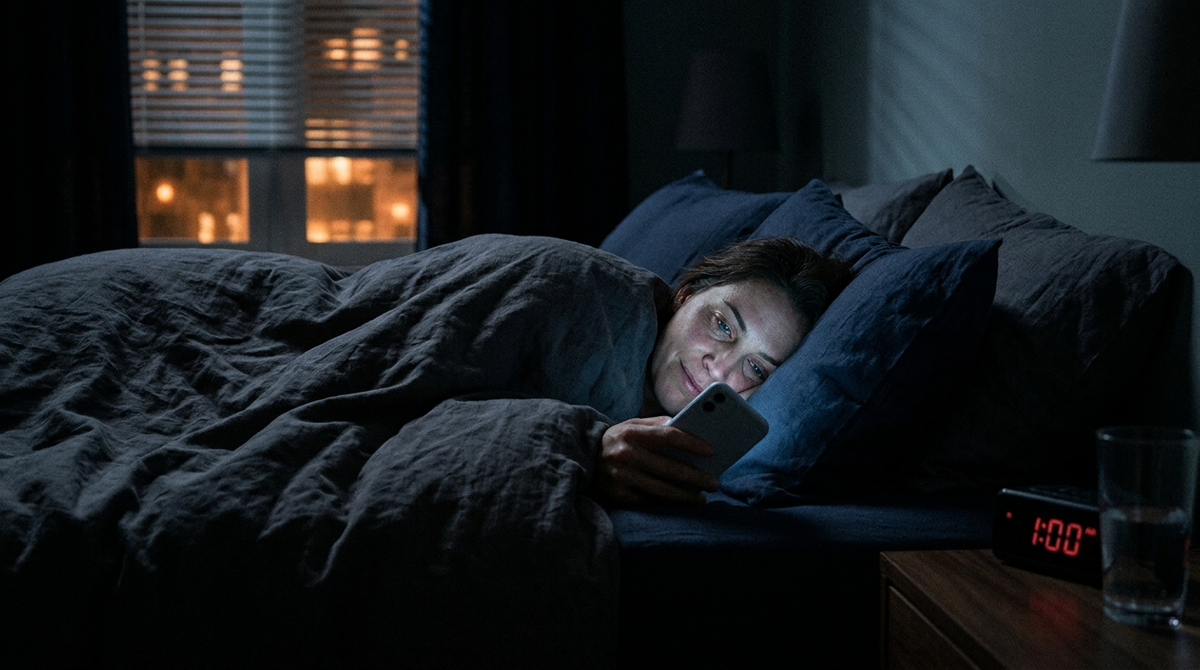
It's 12:47 AM. You have to be up at 6:30. You are fully aware of this. And yet there you are, three episodes deep into a show you don't even like, phone in hand, aggressively refusing to go to sleep. Congratulations: you're not lazy, and you're not broken — you're committing revenge bedtime procrastination, and it's quietly wrecking your nights.
The term (translated from the Chinese phrase bàofùxìng áoyè, "retaliatory staying up late") describes exactly what it sounds like: your day took everything from you, so at night you take revenge — by stealing hours back from the only person available. Which is, unfortunately, tomorrow's you. Tomorrow's you did nothing wrong. Tomorrow's you is going to be furious.
Quick answer: Revenge bedtime procrastination is the deliberate delay of sleep to reclaim personal free time lost to daytime obligations, even though you know it will cost you tomorrow. It is driven by a lack of daytime control — not a lack of discipline — and the most effective fix is restructuring your evening (scheduled me-time, a fixed "closing time," and a wind-down ritual you enjoy) rather than relying on willpower at midnight.
TL;DR — the short version
- Revenge bedtime procrastination = deliberately staying up late to reclaim "me time" your day didn't give you — despite knowing exactly how much you'll pay for it.
- It's not a discipline problem. It's a control problem: your schedule owned you all day, and late night is the only territory left.
- The cost compounds: short sleep → worse mood and focus → worse day → more need for "revenge" → shorter sleep. A perfect, miserable loop.
- The fix isn't more willpower at midnight. It's building real me-time earlier, giving your day a "closing time," and making the wind-down something you actually want.
What is revenge bedtime procrastination?
Revenge bedtime procrastination is choosing to go to bed later than you intended — with no external reason stopping you — in order to claw back free time your day never gave you. Sleep researchers call the base behavior "bedtime procrastination"; the "revenge" variant adds the motive. No crying baby. No night shift. Nothing but you, a glowing rectangle, and a vague sense of defiance.
When your entire day is claimed by work, commuting, family logistics, and other people's priorities, the hours after midnight can feel like the only time that's actually yours. So you stay up. Not because the scrolling is good — you've seen those videos before — but because going to sleep feels like surrendering the last scrap of the day to your calendar.
It's self-sabotage with a sympathetic backstory. Which is why yelling "just go to bed" at yourself has never once worked.
Why your brain does this to you
1. It's about control, not entertainment
Research on bedtime procrastination keeps pointing at the same culprits: low perceived control over daytime hours and depleted self-regulation by night. By 11 PM you've spent an entire day making decisions and suppressing the urge to walk out of meetings. Your willpower tank is empty — precisely when you need it for the deeply boring choice of going to sleep.
2. You're tired but wired
A stressful day leaves your nervous system idling high. Add a bright screen firing dopamine at you every 1.5 seconds, and your brain concludes it's the middle of an exciting afternoon. We covered the mechanics in how doom-scrolling destroys your sleep — spoiler: infinite feeds are engineered to beat your bedtime, and they're very good at their job.
3. The math feels rational at midnight
"I only got 30 minutes to myself today, so I deserve two more hours" feels fair in the moment. But you're buying those hours with tomorrow's focus, patience, and mood — at a brutal interest rate. It's a payday loan, except the currency is sleep.
The bill always comes due
Chronically shorting your sleep doesn't just make you groggy. Night after night, it's associated with worse concentration, worse emotional regulation, more irritability, and a nervous system that treats a group chat notification like a bear attack. And here's the cruel part: the worse your days feel, the more your brain craves nighttime revenge — which shortens your sleep, which makes your days worse. The loop feeds itself. The revenge is on you.
How to actually stop (without becoming a monk)
You don't beat revenge bedtime procrastination with midnight willpower — willpower is the one resource guaranteed to be gone by then. You beat it by redesigning the evening so the revenge isn't necessary.
Schedule the "me time" you keep stealing
The grievance is legitimate: you really didn't get time for yourself. So put it on the calendar like a meeting with someone important — because it is. Even 45 protected minutes at 8:30 PM, with no chores, no email, and nothing "productive," dramatically lowers the urge to seize that time at 1 AM instead.
Give your day a closing time
Businesses close. Your day should too. Pick a "last call" — say 10 PM — when the day is officially over: screens down, lights lower, done means done. What makes the line stick is having a repeatable ritual on the other side of it; we built a complete one in how to build a nighttime routine for better sleep.
Make the wind-down the treat
Part of why you resist bed is that "going to sleep" feels like a chore while "one more episode" feels like a reward. Flip it. A hot shower, a paper book, stretching, a ridiculous skincare routine — give the end of the day its own small pleasure so bed stops feeling like defeat and starts feeling like the point.
Quiet the racing brain
Sometimes you finally put the phone down and your brain immediately starts a podcast about everything you said in 2019. If that's your bottleneck, read our guide to quieting a racing brain at night. And consider giving your wind-down ritual some backup: many people find that a full-spectrum CBD gummy about an hour before "last call" helps them ease off the day's momentum and relax into the evening, which makes choosing an earlier bedtime a lot less painful.
Make bedtime the win, not the surrender
Doze Drops are doctor-formulated sleep gummies with 50mg full-spectrum CBD + 20mg CBN + 20mg CBG — zero sugar, non-habit-forming, and designed to help you wind down when the day is finally, officially over.
$29.99 · 30-day money-back guarantee.
Frequently asked questions
Is revenge bedtime procrastination a sleep disorder?
No. It's a behavior pattern, not a medical diagnosis — you're choosing (under duress) to delay sleep, not failing to fall asleep once you try. If you go to bed on time and still lie there wide awake, that's a different problem, and worth discussing with a healthcare professional if it persists.
Why do I only do this on worknights?
Because worknights are when your day is most thoroughly claimed by other people. The less autonomy your daytime hours have, the more your brain demands compensation at night. Most people notice it's worst after their most controlled, meeting-dense days.
Does putting my phone away actually fix it?
It helps — the infinite feed is the most convenient revenge tool ever invented — but it doesn't address the motive. If you don't build real me-time into your evening, your brain will find another way to stay up out of spite. Fix the schedule first, then the screen.
Can CBD help with revenge bedtime procrastination?
CBD is not a cure for staying up late, and no gummy will confiscate your phone. What it may support is the wind-down itself: many people find that a consistent evening ritual that includes full-spectrum CBD helps them relax and disengage from the day, which makes an earlier bedtime easier to actually choose. As always, talk to your doctor before adding any supplement.
These statements have not been evaluated by the Food and Drug Administration (FDA). This product is not intended to diagnose, treat, cure, or prevent any disease. The information provided is for educational purposes only and is not medical advice. Always consult a healthcare professional before starting any new supplement, especially if you are pregnant, nursing, have a medical condition, or take medications. Results may vary. Everwell does not make any health claims regarding its CBD products.