
Wisdom For Your Dome
Sleep Onset vs. Sleep Maintenance Insomnia: Which Do You Have?
Reviewed by Dr. Pegah Panahi, MD — 25+ years in holistic and cannabinoid medicine.
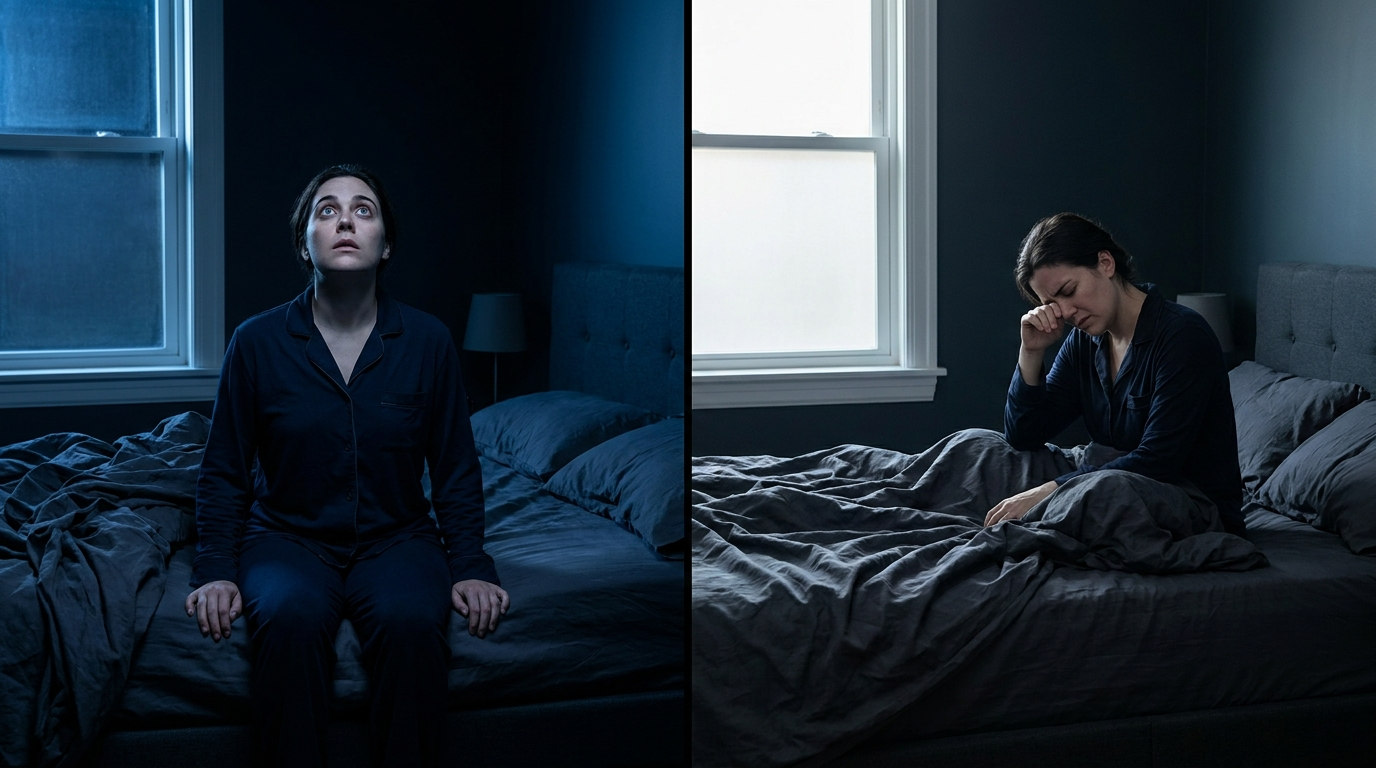
Quick answer: Sleep onset insomnia means you can't fall asleep at bedtime; sleep maintenance insomnia means you fall asleep fine but wake during the night and can't get back down. They have different root causes — racing thoughts and an overactive nervous system for onset, cortisol spikes and blood sugar crashes for maintenance — and they respond to different fixes.
There are two very different flavors of "I didn't sleep last night," and if you keep treating them the same way, you're going to keep failing. Sleep maintenance insomnia is when you fall asleep just fine and then jolt awake at 2, 3, or 4 AM staring at the ceiling doing math you don't care about. That's a completely different beast than lying there for two hours trying to fall asleep in the first place. Same complaint — "I can't sleep" — two different problems, two different fixes. Let's sort out which one is wrecking your nights.
TL;DR — The Short Version
- Sleep onset insomnia = you can't fall asleep. Your brain won't shut up at bedtime.
- Sleep maintenance insomnia = you fall asleep fine but wake up in the middle of the night and can't get back down.
- They have different root causes (racing thoughts vs. cortisol spikes and blood sugar crashes) and respond to different fixes.
- Melatonin is built for onset issues — it does almost nothing for maintenance insomnia, which is why it fails so many people.
- A full-spectrum CBD + CBN + CBG formula (like Doze Drops) can support both, since it targets the nervous system instead of just knocking you out.
What Is Sleep Onset Insomnia?
Sleep onset insomnia is the classic version everyone pictures: lights off, phone down, and your brain decides now is the perfect time to replay every awkward conversation from 2019. You're wired, wound up, and staring at the ceiling for 30, 60, sometimes 90 minutes before you finally drift off. The cause is usually an overactive nervous system that hasn't gotten the memo that the day is over — too much screen time, too much caffeine too late, or just a brain that runs hot at night.
What Is Sleep Maintenance Insomnia?
Sleep maintenance insomnia is sneakier. You fall asleep without a fight — sometimes even fast — and then, like clockwork, you're awake again a few hours later. Your heart might be racing a little. Your mind starts spinning. And falling back asleep can take longer than it took to fall asleep the first time. If this is your pattern, sleep maintenance insomnia is usually driven by cortisol spikes, blood sugar crashes, or a nervous system that can't stay in "off" mode for a full eight hours.
The 3AM Wake-Up Special
If your particular flavor of misery has a suspiciously consistent wake-up time, you're not imagining it — there's a physiological reason your body keeps hitting the same alarm. We go deep on exactly why this happens in why you wake up at 3AM every night, but the short version is: it's rarely random, and it's almost never "just stress."
Why the Difference Actually Matters
Here's the part nobody tells you at the drugstore: most over-the-counter sleep aids are built for one problem, not both. Melatonin is a signal to your brain that it's nighttime — helpful if you can't fall asleep, close to useless once you're already asleep and wake up hours later. That's a huge reason so many people take melatonin, still wake up at 3AM, and conclude "nothing works for me." Nothing didn't work. The wrong tool was used for the job. Getting the diagnosis right — sleep onset insomnia vs. sleep maintenance insomnia — is the first step to actually fixing it instead of throwing gas-station supplements at the wall.
What Actually Helps Each Type
For Sleep Onset Insomnia
- Cut caffeine after early afternoon — it has a longer half-life than you think.
- Build a genuine wind-down window instead of going from scrolling to lights-out. We've mapped out a full nighttime routine for better sleep if you need a starting point.
- Address racing thoughts directly instead of just trying to power through them — see our guide on CBD for anxiety and sleep for how to actually quiet a wired brain at bedtime.
For Sleep Maintenance Insomnia
- Stabilize blood sugar before bed — a crash at 2AM is a common trigger for a hard wake-up.
- Support your body's cortisol rhythm instead of fighting it after the fact.
- Consider a formula designed to support your nervous system through the whole night, not just the first 20 minutes of it. Our full breakdown on how to use CBD for deep sleep covers this in more depth.
Doze Drops: Built for the Whole Night, Not Just Bedtime
50mg full-spectrum CBD + 20mg CBN + 20mg CBG, zero sugar, doctor formulated, non-habit-forming. Doze Drops are designed to help support your nervous system whether your problem is falling asleep or staying that way — no grogginess, no melatonin hangover, no gas-station CBD nonsense. $29.99, backed by a 30-day guarantee.
When to See a Doctor
Occasional bad nights are normal. But if sleep maintenance insomnia or sleep onset insomnia has been a near-nightly pattern for more than a few weeks, or it's affecting your ability to function during the day, it's worth talking to a doctor. Chronic insomnia can be tied to underlying issues — thyroid, sleep apnea, anxiety disorders — that a supplement, however good, isn't designed to fix on its own.
Frequently Asked Questions
Can you have both sleep onset and sleep maintenance insomnia?
Yes, and it's more common than you'd think. Some people struggle to fall asleep and wake up in the middle of the night. If that's you, both the wind-down side and the overnight-support side of your routine need attention.
Is sleep maintenance insomnia worse than sleep onset insomnia?
Neither is objectively "worse" — they're just different. That said, many people find sleep maintenance insomnia more frustrating because falling back asleep after a middle-of-the-night wake-up can feel harder than falling asleep the first time.
Why doesn't melatonin help my sleep maintenance insomnia?
Melatonin is a "time to go to sleep" signal, not a "stay asleep" mechanism. It can help you fall asleep faster, but it doesn't do much once you're already asleep — which is exactly when maintenance insomnia strikes.
Can CBD help with sleep maintenance insomnia?
Many people find that full-spectrum CBD, especially combined with CBN and CBG, may support a calmer nervous system through the night rather than just sedating you at bedtime. It's not a cure or a guarantee — but it's a different mechanism than melatonin, which is why it works for people melatonin has failed.
These statements have not been evaluated by the Food and Drug Administration (FDA). This product is not intended to diagnose, treat, cure, or prevent any disease. The information provided is for educational purposes only and is not medical advice. Always consult a healthcare professional before starting any new supplement, especially if you are pregnant, nursing, have a medical condition, or take medications. Results may vary. Everwell does not make any health claims regarding its CBD products.