Wisdom For Your Dome
Can't Fall Asleep? A 20-Minute Wind-Down Protocol That Actually Works
Reviewed by Dr. Pegah Panahi, MD — 25+ years in holistic and cannabinoid medicine.
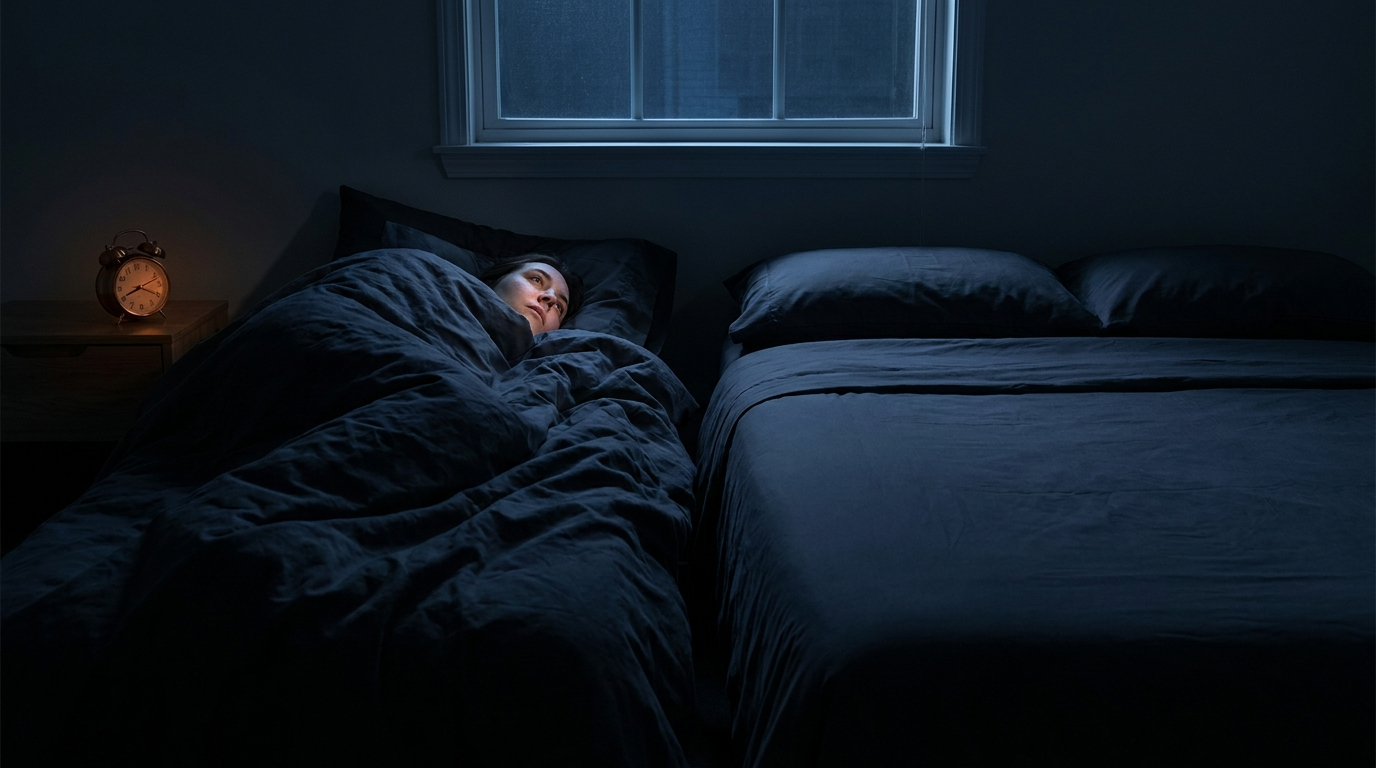
It's 11:47 PM. You did everything right — you're in bed at a reasonable hour like a functioning adult — and yet you can't fall asleep. Your body is exhausted. Your brain, meanwhile, has decided this is the perfect moment to replay an awkward conversation from 2019 and draft tomorrow's to-do list. Sound familiar? You don't need a two-hour "sleep hygiene" ritual involving mouth tape and a $400 sunrise lamp. You need an off-ramp. Here's a 20-minute wind-down protocol that actually gives your nervous system one.
The short version (TL;DR)
- You can't fall asleep because your brain is still in "on" mode — sleepiness and stress arousal are two separate dials, and arousal wins.
- The fix isn't willpower. It's a repeatable 20-minute off-ramp: brain dump, lights down, body down, screens gone.
- Minutes 0–5: dump tomorrow onto paper. Minutes 5–10: kill the bright lights and screens. Minutes 10–15: slow physiology down (breathing, stretching, warm shower). Minutes 15–20: boring input only, then bed.
- If you're not asleep in ~20 minutes, get up. Lying there marinating in frustration trains your brain that bed = stress.
- Many people add a full-spectrum CBD gummy about an hour before the protocol to help take the edge off. It supports the wind-down — it doesn't replace it.
Why you can't fall asleep (even when you're exhausted)
Falling asleep requires two things: enough sleep pressure (the biological drive that builds the longer you're awake) and low arousal (a nervous system that's actually off duty). Most people who can't fall asleep have plenty of the first and none of the second. That's the classic "tired but wired" state — your body is done, but your stress hormones didn't get the memo.
Blame biology. Stress hormones like cortisol and adrenaline evolved to keep you alert when something might eat you. Your brain can't tell the difference between a predator and an unread email from your boss, so it runs the same program: heart rate up, thoughts racing, sleep canceled. If this happens at the start of the night, that's sleep onset insomnia — we broke down the difference in sleep onset vs. sleep maintenance insomnia.
The good news: arousal is a dial, not a switch, and you can turn it down on purpose. That's the whole point of the protocol.
The 20-minute wind-down protocol
Twenty minutes. Four steps. Do them in order, same order every night, because repetition is what teaches your brain "this sequence means sleep is coming." It's the same conditioning logic behind a full nighttime routine, compressed for people who will never do 90 minutes of anything.
Minutes 0–5: Dump your brain
Grab paper — actual paper, not your phone — and write down everything your brain will otherwise save for 12:30 AM: tomorrow's tasks, the thing you forgot, the thing you're dreading. Research on "constructive worry" suggests that scheduling your worrying on paper before bed leaves less of it for the pillow. You're not solving anything. You're telling your brain, "It's written down. You can stop rehearsing it."
Minutes 5–10: Kill the lights, ditch the screens
Overhead lights off, lamps on, phone out of reach — ideally out of the room. Bright light and doom-scrolling both push arousal up right when you need it down. Screens are a double hit: light plus algorithmically engineered outrage. If your brain is racing because of what you just read, that's not a sleep problem, that's an input problem — more on that in how to quiet racing thoughts at night.
Minutes 10–15: Slow the body down
Pick one, not all:
- Slow breathing. In for 4, out for 6–8. Long exhales nudge the parasympathetic ("rest and digest") system. Five minutes of this is unglamorous and effective.
- Light stretching. Neck, shoulders, hips. You're releasing the tension of a day spent shaped like a question mark over a laptop.
- A warm shower. The post-shower drop in core body temperature is a natural sleep signal.
Minutes 15–20: Boring input only, then bed
Read something on paper that won't grip you — no thrillers, no news, nothing with a comment section. The goal is gentle boredom. Then lights out. If you're still awake 20 minutes later, get up, sit somewhere dim, read something dull, and come back when you're actually sleepy. Lying in bed fuming about not sleeping teaches your brain that bed is where the fuming happens.
What NOT to do when you can't fall asleep
- Don't check the time. Clock math ("if I fall asleep NOW I get 5 hours 12 minutes") is arousal fuel.
- Don't grab your phone. You know this. Do it anyway. The phone charges in the kitchen now.
- Don't pour a nightcap. Alcohol can make you drowsy, then fragments your sleep in the second half of the night.
- Don't "catch up" with a 4 PM espresso the next day. That's how tonight's problem becomes tomorrow's.
Where CBD fits in (and where it doesn't)
A wind-down protocol lowers arousal behaviorally. Some people like a little biochemical backup too. Many people find that full-spectrum CBD helps them feel more relaxed and makes it easier to wind down — which is exactly the state this protocol is trying to build. It's not a sedative and it won't knock you out mid-sentence; think of it as turning down the background noise so the off-ramp is easier to take. Because gummies take time to kick in, take one about 30–60 minutes before you start the protocol — timing details in how long CBD takes to work.
Doze Drops: the off-ramp, in gummy form
50mg full-spectrum CBD + 20mg CBN + 20mg CBG per serving. Zero sugar. Doctor formulated. Non-habit-forming. Designed to help you wind down and stay down — no melatonin hangover, no gas-station mystery gummies.
$29.99 · 30-day money-back guarantee.
Frequently asked questions
Why can't I fall asleep even when I'm exhausted?
Because sleepiness and arousal are two separate systems. You can have maximum sleep pressure and still be wide awake if stress hormones are keeping your nervous system in "on" mode. The fix is lowering arousal — not trying harder to sleep, which ironically raises it.
How long should it normally take to fall asleep?
Roughly 10–20 minutes is typical. Falling asleep in under 5 minutes usually means you're sleep-deprived; regularly taking 45+ minutes suggests your wind-down (or lack of one) needs work.
Should I stay in bed if I can't fall asleep?
No. After about 20 minutes, get up, go somewhere dim, do something boring, and return when sleepy. This is a core technique from behavioral sleep medicine — it keeps your brain from associating your bed with frustration.
Can CBD help me fall asleep?
CBD isn't a sedative, but many people find it supports relaxation and makes it easier to wind down — a useful companion to a consistent routine like this protocol. Full-spectrum formulas that include CBN and CBG are a popular choice for nighttime use.
The bottom line
You can't argue your brain into sleep, but you can walk it there. Twenty minutes, four steps, same order every night: dump the brain, dim the world, slow the body, bore yourself to bed. Do it for two weeks and "I can't fall asleep" starts becoming "I don't remember falling asleep." That's the goal — sleep like the dead, wake up human.
These statements have not been evaluated by the Food and Drug Administration (FDA). This product is not intended to diagnose, treat, cure, or prevent any disease. The information provided is for educational purposes only and is not medical advice. Always consult a healthcare professional before starting any new supplement, especially if you are pregnant, nursing, have a medical condition, or take medications. Results may vary. Everwell does not make any health claims regarding its CBD products.